Your Feet Are Quietly Giving Up on You: The Hiking Injuries Hiding in Plain Sight
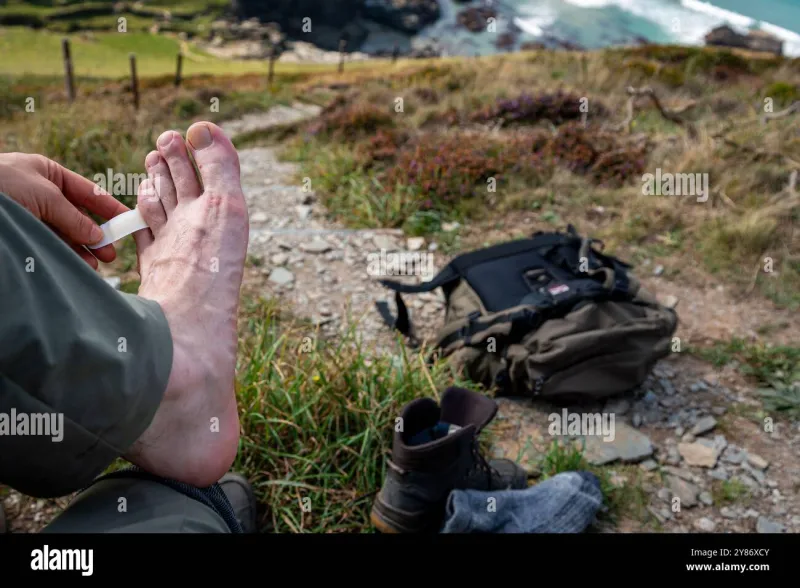
Photo: hiker treating blisters on trail feet close up hiking boots, via c8.alamy.com
You spent weeks planning the route. You broke in your boots. You bought the moisture-wicking socks everyone on Reddit swore by. And then, somewhere around mile six of a ten-mile day, you felt it — that slow, unmistakable burn on the back of your heel, or maybe a deep ache radiating through your arch, or the weird numbness under your second toe that would eventually mean losing a toenail at a Comfort Inn in Gatlinburg.
Foot injuries are the quiet saboteurs of outdoor adventure. They rarely make the dramatic injury stories hikers swap around a campfire. Nobody posts a photo of their blister on Instagram. But they're responsible for more abandoned trails, cut-short thru-hikes, and miserable final miles than any sprained ankle or altitude headache. And the frustrating part? Most of them are preventable — just not in the ways you've been told.
The Four Foot Injuries That Wreck Long-Distance Hikers
Before you can fix something, you need to understand what's actually breaking. Sports podiatrist Dr. Melissa Crane, who works with endurance athletes and long-distance hikers out of Denver, Colorado, says she sees the same four conditions cycling through her clinic every hiking season.
Blisters are the most obvious and, counterintuitively, the most misunderstood. "People think blisters are just a friction problem, but they're really a heat and moisture problem first," she explains. When your foot sweats inside a boot — especially on a warm day or a steep climb — the skin softens, becomes more vulnerable, and friction does its damage far faster. The sock-on-sock layering trick (wearing a thin liner sock under a thicker hiking sock) works precisely because it shifts the friction point away from your skin.
Toenail loss — technically called subungual hematoma when blood pools under the nail — is almost always caused by the foot sliding forward inside the boot on descents. Your toenail takes repeated impacts against the toe box, bruises, and eventually detaches. It's more common than hikers realize. Ask anyone who's completed a serious descent, like the Grand Canyon's South Kaibab Trail, and a good portion of them have a toenail story.
Plantar fasciitis is the one that sneaks up on you. It starts as mild morning stiffness, graduates to a stabbing heel pain on your first steps, and if ignored long enough, becomes a months-long recovery project. The plantar fascia — a thick band of connective tissue running along the bottom of your foot — gets overloaded when hikers ramp up mileage too quickly, wear worn-out footwear, or hike long distances with inadequate arch support.
Metatarsal stress fractures are the injury nobody suspects until a doctor shows them the X-ray. These tiny cracks in the long bones of the forefoot develop from repetitive loading — think back-to-back high-mileage days on hard-packed trail or rocky terrain. They often feel like a vague, spreading ache across the top of the foot that gets worse as the day goes on. Hikers routinely push through them for days before the pain becomes impossible to ignore.
Why Good Boots Aren't Enough
Here's where the conventional advice breaks down. The outdoor industry has done a masterful job convincing hikers that the right gear solves everything. And gear matters — but it's only part of the equation.
Take boot fit. Most people size their hiking boots the same way they'd size a sneaker. That's a problem. "Your feet swell during a hike — sometimes by a full half-size," Dr. Crane notes. "If you're buying boots in the morning at REI and they feel snug, they'll feel like a vice grip by mile eight on a hot day." The standard advice is to buy boots a half-size up and try them on in the afternoon when your feet are already slightly swollen.
But even perfectly fitted boots can't compensate for biomechanical issues. Hikers with high arches, flat feet, or overpronation put abnormal stress on specific structures with every single step. Over flat terrain, your body can usually absorb that. Over ten miles of uneven trail with a 30-pound pack? It can't. Custom or semi-custom orthotics — not the foam insoles that come with most boots — can be genuinely transformative for hikers dealing with chronic foot problems.
Jason Merritt, a 42-year-old from Asheville, North Carolina, spent three consecutive summers nursing plantar fasciitis that started fresh every spring. "I tried everything — new boots, stretching, rolling my foot on a tennis ball. Nothing stuck," he says. "A podiatrist finally looked at my gait on a treadmill and told me I was a severe overpronator. I got custom orthotics and didn't have a single flare-up the next season."
When to Push Through and When to Stop
This is the question every hiker eventually faces on the trail, and the honest answer is more nuanced than "listen to your body" (though that's not wrong).
Blisters: Generally manageable with proper treatment. Clean the area, use a moleskin donut or blister-specific bandage to offload pressure, and keep going if the pain is tolerable. Popping a blister is controversial — if you do, sterilize the needle, drain from the edge, leave the skin intact as a protective layer, and cover it.
Toenail pain: Uncomfortable, rarely dangerous. Finish the hike, ice it, and accept that you might lose the nail over the next few weeks. It grows back.
Plantar fasciitis: Depends on severity. Mild cases can be managed with stretching before you start each morning and taking it easy on steep terrain. A sharp, worsening heel pain that changes your gait is a signal to stop — hiking through it risks a longer recovery.
Suspected stress fracture: Stop. This is the one injury where pushing through can turn a minor crack into a complete fracture requiring weeks of non-weight-bearing rest. If you have localized bone pain on the top of your foot that intensifies with activity, get off the trail and get it imaged.
Prevention That Actually Works
Beyond gear, here are the strategies that sports podiatrists and experienced long-distance hikers actually rely on:
Toughen your skin before a big trip. Gradual mileage buildup isn't just for fitness — it gives your skin time to callus in the right places. Don't schedule a 15-mile day as your first hike of the season.
Lace your boots for the terrain. Heel-lock lacing (looping the laces through the top hooks before crossing) prevents the forward slide that destroys toenails on descents. Look it up — it takes 30 seconds and makes a real difference.
Dry your feet at lunch. On multi-day trips, taking your boots off at midday, airing your feet, and changing to dry socks dramatically reduces blister risk. It feels like a luxury; it's actually maintenance.
Strengthen your feet off-trail. Single-leg calf raises, toe spreads, and towel scrunches sound absurdly simple, but foot and ankle strength is genuinely protective against both plantar fasciitis and stress fractures. Most hikers train their legs and ignore everything below the ankle.
Respect the ramp-up. Stress fractures almost always follow a sudden spike in mileage or difficulty. If you're planning a serious trip — a section of the Appalachian Trail, a Colorado 14er, a multi-day desert route — build up to it over weeks, not days.
Your feet carry you to every summit. They absorb every rock, every root, every mile of descent. Treat them like the precision instruments they are, not an afterthought you address when something starts hurting. The trails will still be there — but only if you show up with feet that can handle them.