When Good Gear Goes Bad: The Hidden Habits That Kill Your Hiking Equipment
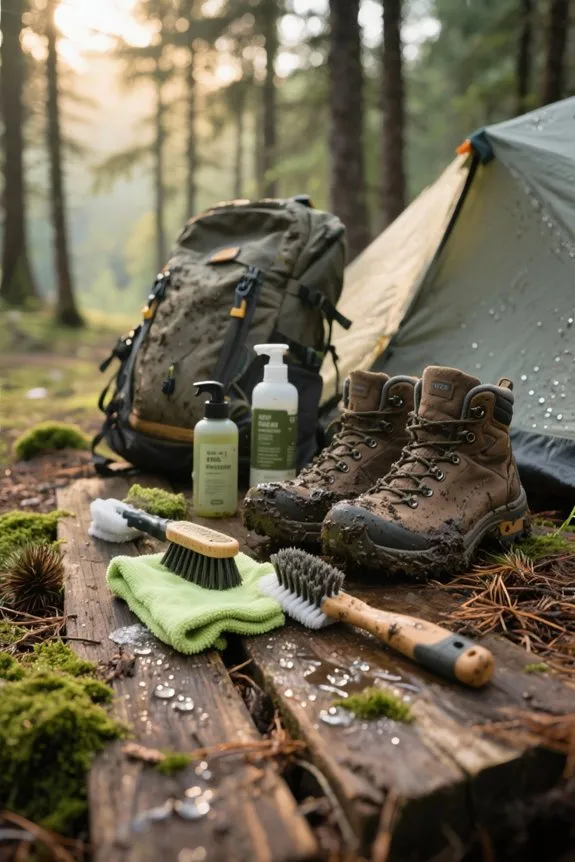
Photo: hiking gear maintenance cleaning boots backpack outdoors, via campgearcore.com
It's mile seven. The sky has turned that particular shade of slate gray that means business, and you reach for your rain jacket — the one that cost you $280 and came with a lifetime guarantee. You pull it on. Within twenty minutes, you're soaked to the skin. The jacket, technically waterproof by every label and spec sheet, is doing absolutely nothing.
This isn't a defective product story. It's a maintenance story. And it plays out on trails all across the country every single weekend.
Gear failure rarely happens because the gear was bad. It happens because hikers treat their equipment like it's indestructible — and manufacturers, frankly, don't go out of their way to advertise how fragile their products actually are under real-world conditions.
The DWR Problem Nobody Talks About
That rain jacket situation? Almost certainly a dead DWR coating. DWR stands for Durable Water Repellent — the invisible treatment applied to the outer face fabric of waterproof-breathable shells that makes water bead up and roll off instead of soaking in.
Here's the thing: DWR is not actually that durable. It degrades with every wash, every compression into a stuff sack, every time you rub against a pine branch on a narrow singletrack. Most jackets need their DWR refreshed after five to ten washes, sometimes sooner depending on how hard you're pushing the trail.
The fix is almost embarrassingly simple — a can of Nikwax or Grangers spray-on treatment, or a wash with a DWR-restoring cleaner. But most hikers have never heard of this. They just assume the jacket quit on them, shove it in a closet, and eventually buy another one. The outdoor industry, to put it gently, is not crying about this cycle.
Boots Are Not Forever (But They Can Last a Lot Longer)
A well-made pair of hiking boots can theoretically handle 500 to 1,000 miles of trail. In practice, most hikers get far less out of them — and usually blame the brand.
The real culprit is almost always storage and cleaning habits. Leather boots stored in a hot garage develop micro-cracks in the upper that compromise waterproofing and structural support. Synthetic boots left dirty after a muddy trip trap moisture against the materials, accelerating breakdown from the inside out. And nearly everyone makes the same mistake: drying wet boots next to a heat source — a camp stove, a fireplace, a radiator — which causes adhesives to soften and midsoles to separate.
Boots should be cleaned after every outing with a soft brush and mild soap, stuffed loosely with newspaper to maintain shape, and stored in a cool, dry place out of direct sunlight. Leather uppers need conditioning two to three times a season with a product like Nikwax Leather Conditioner or Sno-Seal. These steps take maybe fifteen minutes total. Almost nobody does them.
Your Pack Is Slowly Eating Itself
Backpacks are deceptively resilient-looking. The fabric is tough, the frame seems solid, the buckles click satisfyingly. But there are weak points that accumulate damage invisibly until something gives out — usually at the worst possible time, like when you're three miles from the trailhead with thirty pounds on your back.
Hip belt padding compresses permanently over time, which shifts weight distribution off your hips and onto your shoulders. That's not just uncomfortable — it's a recipe for neck and shoulder strain on longer hauls. Most manufacturers recommend replacing hip belt foam every few years of heavy use, but almost no one knows this is even an option.
Frame sheets, the internal stiffeners that give a pack its structure, can warp if the pack is stored folded or crammed into tight spaces repeatedly. Compression straps and load lifters lose elasticity, which means your load shifts around more than it should on technical terrain.
After every trip, empty your pack completely, shake out debris, and wipe down the interior with a damp cloth. Store it hanging or loosely stuffed — not compressed — in a dry environment. Check buckles and straps for cracking or fraying at least once a season.
Trekking Poles: The Gear Nobody Maintains
Trekking poles are probably the most neglected piece of gear in any hiker's kit. They get used hard, thrown in a car trunk, and forgotten about until the next trip.
The twist-lock and lever-lock mechanisms that allow poles to telescope are particularly vulnerable. Dirt and grit work their way into the locking mechanisms, causing them to slip under load — which is a serious problem when you're depending on a pole for balance on a steep descent. Carbide tips wear down and become dangerously smooth on rock. Rubber baskets crack and break off.
After muddy or wet trips, extend your poles fully, rinse them with fresh water, and leave them open to dry completely before collapsing and storing them. Clean the locking mechanisms occasionally with a soft cloth. Replace tips and baskets when they show significant wear — they're inexpensive and widely available.
The Storage Environment Nobody Thinks About
Here's a counterintuitive truth that gear engineers are surprisingly candid about when asked directly: your storage environment does more damage to your gear than the trail does.
Ultraviolet light degrades nylon, polyester, and rubber over time. A pack or tent stored near a window loses tensile strength in the fabric even without any use. Extreme heat — like the inside of a car parked in the sun, or a shed in a Texas summer — breaks down adhesives, degrades foam padding, and accelerates the deterioration of synthetic insulation.
Humidity is equally destructive. Down sleeping bags and insulated jackets stored compressed in stuff sacks in a damp basement lose loft, which is the property that makes them warm. Down should be stored loosely in a large cotton or mesh bag, in a dry environment, ideally hung or laid flat.
The ideal gear storage space is cool, dry, dark, and well-ventilated. A climate-controlled interior closet beats a garage or storage unit almost every time.
What Manufacturers Know That They Don't Advertise
The outdoor industry is full of genuinely excellent products built to perform in brutal conditions. But there's an uncomfortable commercial reality at play: gear that lasts forever doesn't generate repeat sales. Care instructions are often buried in packaging inserts or available only on the brand's website, not prominently featured at point of sale.
This isn't necessarily cynical — companies do want their products to perform well, because reputation matters. But the burden of extending gear life falls almost entirely on the consumer, and most consumers are never taught the basics.
The good news is that the maintenance routines involved are neither complicated nor expensive. A season's worth of proper gear care — DWR refreshing, boot conditioning, pole cleaning, proper storage — costs maybe $30 to $50 in products and a few hours of time. Compare that to replacing a jacket ($200+), a pair of boots ($150-$300), or a quality pack ($150-$350).
The Trail Deserves Your Best Gear
Every summit you're chasing, every trail you're planning to explore this season — it deserves equipment that's actually ready to perform. The mountains don't offer second chances when your waterproofing fails or your pole collapses on a loose scree field.
Treat your gear like the investment it is. Learn what it needs. Give it fifteen minutes of attention after every trip. Store it like it matters. Because when you're standing at the trailhead at 5 a.m., miles from anywhere, the last thing you want is for the gear you trusted to quietly give up on you.