Why Serious Hikers Keep Making Their Lives Harder on Purpose
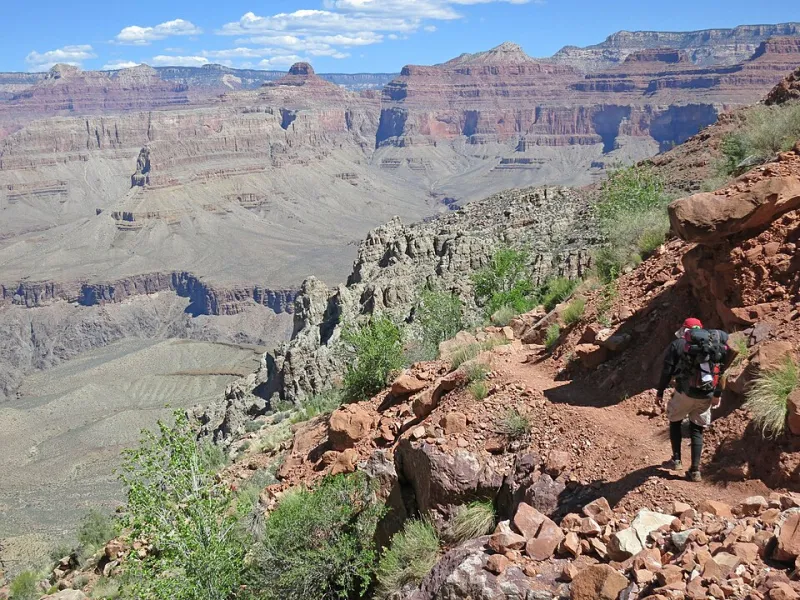
Photo: Grand Canyon National Park, CC BY 2.0, via Wikimedia Commons
Picture this: it's a Saturday morning at a trailhead in Colorado's Front Range. Two hikers stand at the fork. One path is well-maintained, clearly signed, and leads to a reliable summit view in about four miles. The other is an unmaintained use-trail that adds two miles, a scramble section, and a real chance of route-finding headaches. The newer hiker takes the easy path. The veteran barely glances at it before heading toward the harder one.
This scene plays out at trailheads across the country every weekend—from the White Mountains of New Hampshire to the Cascades in Washington State. And the more you dig into why it happens, the more interesting the answer gets.
The Comfort Zone Is Actually Kind of Boring
Sports psychologist Dr. Michael Gervais, who has spent years studying high-performance athletes and outdoor adventurers, often points to a concept called the challenge-skills balance. When a task is too easy relative to your abilities, your brain drifts. You get bored. You start thinking about what you're making for dinner instead of paying attention to your footwork.
But push that difficulty level up—just enough to require your full attention without overwhelming you—and something clicks. Psychologist Mihaly Csikszentmihalyi called this state "flow," that almost meditative zone where effort and ability meet perfectly. Experienced hikers, often without consciously realizing it, are constantly chasing that sweet spot.
"I've done the easy trails near my house so many times I could do them half asleep," says Marcus T., a trail runner and hiker based out of Asheville, North Carolina. "At some point they stopped feeling like hikes and started feeling like errands. I had to go harder just to feel present again."
That craving for presence—for genuine mental engagement with the terrain—is a core driver that easy trails simply can't deliver once you've built a certain baseline of skill.
Building Competence, One Sketchy Ridge at a Time
There's also something deeper happening at the level of identity. Psychologists who study motivation talk about competence building—the intrinsic human drive to get better at things that matter to us. Each harder trail completed doesn't just check a box. It rewires how a hiker sees themselves.
This isn't ego, exactly. It's more like craftsmanship. A carpenter who's been at it for twenty years doesn't get the same satisfaction from cutting a straight line that they did when they were starting out. They need a more complex joint, a trickier design, a problem worth solving. Hiking works the same way.
Researchers at the University of British Columbia studying outdoor recreation motivation found that experienced hikers consistently ranked "skill development" and "overcoming challenge" higher than "relaxation" or "scenery" when explaining why they chose specific routes. Beginners ranked those priorities almost in reverse order.
This isn't to say veterans don't appreciate a gorgeous view—they absolutely do. But the view hits different when you've earned it through a technical ridgeline approach rather than a paved interpretive trail.
The Social Layer Nobody Likes to Admit
Let's be real for a second: community plays a role too, even if hikers don't always want to admit it.
The hiking world has its own informal status culture. Platforms like AllTrails, Strava, and even Instagram have made it easy—almost unavoidable—to share routes, elevation gains, and trip reports. There's a quiet but very real social currency attached to difficult routes. Telling your hiking crew you bagged a Class 4 scramble in Rocky Mountain National Park lands differently than mentioning you walked a nature loop at the state park.
Dr. Rachel Chang, a behavioral scientist who has studied social motivation in outdoor sports communities, describes this as social proof in reverse. "In most consumer contexts, people follow the crowd," she explains. "But in tight-knit outdoor communities, differentiation matters. Doing the harder, less-traveled route signals experience, commitment, and a certain kind of seriousness about the pursuit."
This isn't purely vanity, though the line can get blurry. For many hikers, the community aspect is genuinely motivating in a healthy way—surrounding yourself with people who push limits encourages you to push yours.
When the Hard Route Becomes the Safe Route
Here's a counterintuitive twist: for truly experienced hikers, difficult terrain is sometimes less risky than it looks to outsiders. An exposed ridgeline that would terrify a beginner might feel controlled and manageable to someone with a decade of scrambling experience. Meanwhile, a crowded, heavily trafficked easy trail can create its own hazards—unpredictable foot traffic, overconfident beginners, or the simple mental complacency that comes from underestimating a route.
Veteran hikers often talk about being more comfortable on technical terrain than on busy, well-maintained trails where they feel like they have to manage around other people rather than manage the mountain itself.
"I feel safer on a quiet Class 3 scramble than on a crowded fourteener trail with a bunch of people in cotton t-shirts," admits Priya S., an experienced mountaineer from Denver who has summited peaks across the American West. "At least on the hard route, I know who I'm dealing with."
The Trail Chooses You Back
Maybe the most honest thing you can say about why experienced hikers gravitate toward harder routes is this: at a certain point, the easy trails stop asking anything of you. And hikers—real ones, the kind who keep coming back year after year—need to be asked something.
They need terrain that demands full attention, routes that require decision-making, summits that aren't guaranteed. They need the mountain to push back a little.
That's not masochism. It's the same reason a chess player doesn't keep playing against beginners, or why a surfer paddles past the break they've already mastered. Growth requires resistance. Meaning requires effort.
So the next time you're standing at a trailhead fork and you watch an experienced hiker head confidently toward the harder path, don't assume they're showing off or trying to prove something. Chances are, they've simply learned what the trail has to offer—and they're looking for a conversation that's a little more interesting.
The mountain's still talking. They just need a bigger challenge to hear it clearly.